PleinAirPainting
How to Price Your Plein Air Artwork: A Practical Guide for UK Artists
A practical guide to how to price artwork for plein air painters: total your costs, set a per-linear-inch rate, use cost-plus as a floor, factor location and difficulty, and review prices annually.


Key takeaways
- • Calculate all real costs including your time and use cost-plus to set a minimum price.
- • Adopt a per-linear-inch rate for consistent, easy to explain pricing across sizes.
- • Use cost-plus as a floor and the size-based formula as your working price; adjust the rate if needed.
- • Factor plein air specifics such as studies, provenance, and difficult conditions into tiers and time costs.
- • Keep a written pricing structure, review it annually, and raise prices gradually as demand grows.
Knowing how to price artwork is one of the most common questions among artists who have been painting for a while and have a growing body of work on their hands. Most either pluck a number from thin air, undercharge out of anxiety, or avoid the whole question by not selling at all. None of those approaches serves you well. This guide gives you a working method you can apply to your own paintings today, along with the confidence to put a price on your work and mean it.
Why Pricing Feels So Hard (and Why It Matters)
Painting is personal. When you have spent a cold November morning on a hillside in the Yorkshire Dales, fighting the wind to capture something true about the light, putting a number on the result can feel uncomfortably exposing. What if the number is too high and someone laughs? What if it is too low and you feel you have sold yourself short?
That discomfort is understandable and you are not alone in feeling it. But here is the thing: inconsistent or random pricing does not just leave money on the table, it actively undermines confidence in your work. A buyer who sees a similar painting by the same artist priced at £80 at a craft market one month and £300 on Instagram the next does not think "great, I found a bargain." They think something is off. Consistency is not just good business; it is a form of professionalism that buyers notice and trust.
The Underpricing Trap
Selling too cheaply feels like a safe option when you are starting out, but it creates real problems. Buyers can associate very low prices with low quality, even subconsciously. A small plein air painting for £25 does not read as accessible; it reads as amateur. More practically, once you establish a price point, raising it later is awkward and risks alienating buyers who paid less for similar work. It is far easier to start at a considered price and hold it than to spend years trying to work your way back up.
Start With Your Costs: The Foundation of Any Pricing Method
Before you apply any formula, you need to know what a painting actually costs you to make. Most artists dramatically underestimate this, particularly the time involved. Work through each cost category honestly.
| Cost | What to include | Rough UK estimate |
|---|---|---|
| Materials | Paint, panels or paper, medium, varnish | £10–£40 per painting |
| Framing or presentation | Frame, mount, backing, hanging hardware | £20–£80 per piece |
| Travel | Fuel, train fare, parking, entry to sites | £5–£30 per session |
| Equipment wear | Easel, brushes, palette depreciation | Small but real |
| Time | Your hourly rate × hours spent | The biggest variable |
Time is consistently the cost that artists forget or actively ignore. If you spend three hours on a painting, including setup, travel, and any finishing touches back at home, that time has real value. Even at a modest rate, it adds up quickly. Giving that time away for free is not generosity; it is a subsidy your buyers do not know they are receiving.
Two Reliable Methods for Pricing Plein Air Work
There are two methods worth knowing. Used together, they give you both a floor and a working formula.
The Cost-Plus Method
The cost-plus method is exactly what it sounds like: add up everything the painting cost you to make, include your time at a reasonable hourly rate, then add a margin for profit. This gives you a minimum price you should not go below.
Worked example
Materials: £20. Travel and parking: £10. Time: 3 hours at £20/hr = £60. Framing: £35. Subtotal: £125. Add 40% for gallery commission if selling through a gallery: £175. That is your minimum sale price before any profit. Add a margin on top for what the market will bear.
The cost-plus method is useful precisely because it is grounded in reality. It stops you from setting prices that leave you worse off than if you had not painted at all. Use it as your floor: the number you will not go below under any circumstances.
The Size-Based Formula
The size-based formula is the working method recommended by most professional artists, and for good reason. It is consistent, easy to explain, and scales proportionally across your work. The preferred approach uses linear inches rather than square inches, because square-inch pricing grows too fast at larger sizes and produces numbers that can feel arbitrary.
To calculate linear inches, simply add the two dimensions together. A 6x8 panel is 14 linear inches. A 12x16 is 28. Then set a per-linear-inch rate and apply it consistently to every painting in that tier.
| Panel size | Linear inches | Price |
|---|---|---|
| 6×8 | 14 | £280 |
| 8×10 | 18 | £360 |
| 10×14 | 24 | £480 |
| 12×16 | 28 | £560 |
The rate you choose will depend on your experience, reputation, and the market you are selling into. For an intermediate artist building a reputation, a rate somewhere between £15 and £25 per linear inch for finished paintings is a reasonable starting range. The critical rule is that the rate stays the same across all paintings of the same quality tier. You do not charge more for the one you love and less for the one you are less certain about. Consistency is what makes the formula work.
Which Method Should You Use?
Use both together. Run the cost-plus method first to establish your floor. Then apply the size-based formula to set your actual price. If your cost-plus calculation gives you a higher number than the size formula produces at your current rate, that is a clear signal: your per-linear-inch rate is too low. Adjust it upward until the formula price comfortably clears your costs.
Plein Air-Specific Pricing Considerations
This is where outdoor painting differs from studio work, and where generic pricing advice tends to fall short. There are a few things worth thinking through carefully.
Studies vs. Finished Work
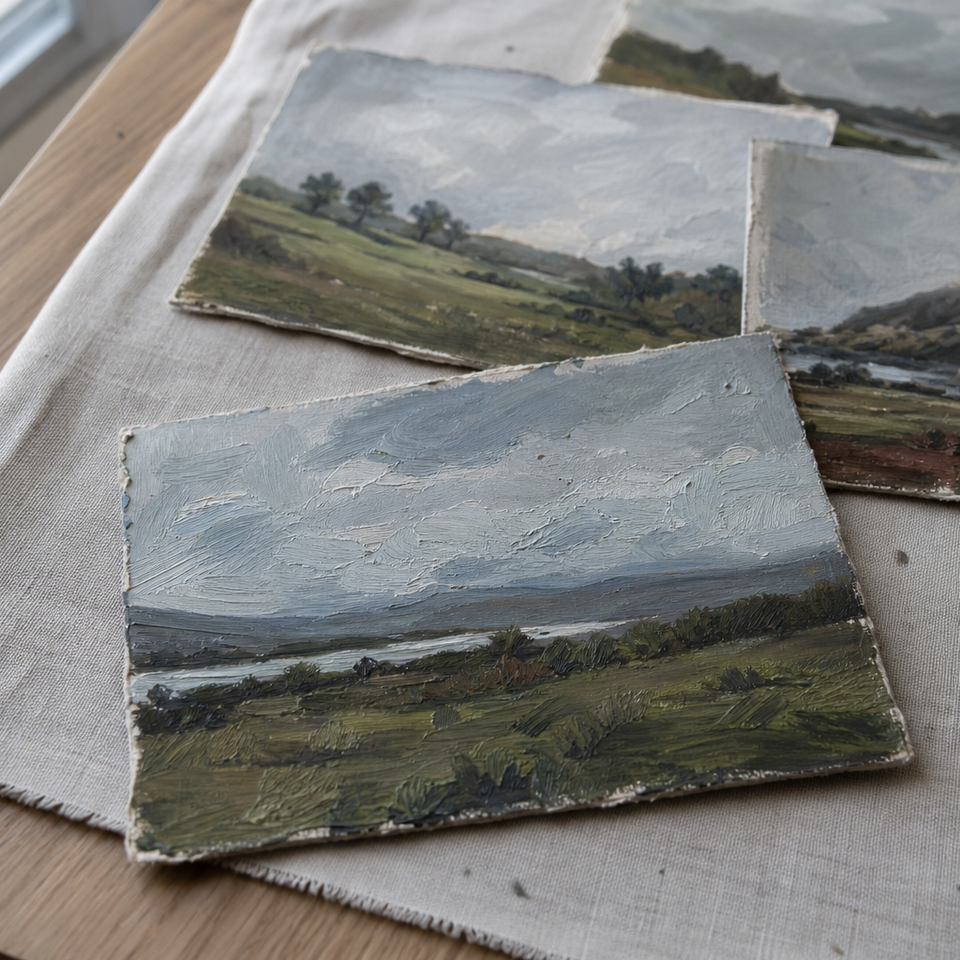
A quick outdoor study painted in an hour on a small panel is a different thing from a considered, resolved painting that involved multiple sessions, careful composition, and finishing work in the studio. Both have genuine value, but they serve different buyers and should sit in different pricing tiers.
The good news is that "study" is not a diminishing label. Many buyers actively prefer studies; they find them energetic, immediate, and more accessible in price. Being clear and consistent about which tier a painting belongs to is more important than trying to make every piece feel like a major work. A study priced honestly at £150 to £250 is a different offer from a finished painting at £400 to £600. Both are legitimate. Neither should feel apologetic.

Does "Painted Outdoors" Add Value?
Yes, it genuinely does, for the right buyer. The story of where a painting was made is part of what you are selling. A view of the Cornish coast painted on location at low tide, or a misty morning in the Lake District captured in the field, carries a different kind of authenticity from the same subject produced in a studio from a photograph. That authenticity has real appeal and you should not be shy about communicating it in your titles and descriptions.
That said, "painted outdoors" is context, not a substitute for quality. The painting still has to earn its price on its own merits. Use the provenance story to support the value; do not lean on it to prop up work that is not ready for sale.

Camille Pissarro, The Côte des Bœufs at L'Hermitage, 1877. by Camille Pissarro; National Gallery, London - online catalogue. Public domain.
Condition and Difficulty Factors
Painting in driving rain on a Northumberland clifftop in February involves more effort than painting on a still, sunny day. You do not need to itemise every hardship on your price list (though some artists have taken exactly that approach, with mixed results). What you should do is factor genuine difficulty honestly into your time cost. If a session took twice as long because of difficult conditions, account for those hours. That is enough.
Selling in the UK: How the Market Affects Your Prices
Gallery Commissions in the UK
UK galleries typically take between 40% and 50% commission on sales. This is standard and worth building into your pricing from the start. The key principle is this: your retail price is your retail price everywhere. If a painting is priced at £400, the gallery takes their 40% and you receive £240. You should be happy with that £240 before the painting goes on the wall.
Never set your direct-sale price and then offer the same price to a gallery; you will end up receiving far less than you planned. The gallery price and the direct-sale price should be identical. You simply keep more when you sell directly.
Co-operative galleries, common in some parts of the UK, work differently: artists typically pay a membership fee or contribute days of staffing in exchange for lower or zero commission. If there is a co-operative gallery in your area, it is worth understanding their model, as it can suit artists at exactly the stage described in this guide.
Open Studios, Art Fairs, and Markets
Open Studios events are a major part of the UK art calendar, particularly in counties like Suffolk, Devon, Oxfordshire, and Cornwall, where they are well established and attract serious buyers. Art fairs such as the Affordable Art Fair provide access to buyers actively looking for original work in the accessible price range. Local craft markets offer a lower barrier to entry and good direct feedback from the public.
All of these are direct-sale channels, meaning you keep the full price. The temptation can be to drop prices for these settings, especially if sales feel slow on the day. Resist it. Do not discount your prices for direct sales. Doing so confuses buyers who may have seen your work elsewhere and undermines the consistency that makes your pricing trustworthy. The fact that you keep the full amount is already the advantage.
Selling Online
Platforms used by UK artists include Artfinder, Etsy, and Instagram (via DMs or linked shops), as well as artist-owned websites. Each platform has its own fee structure. Artfinder takes a commission; Etsy charges listing and transaction fees; running your own site involves hosting and payment processing costs. Factor these into your pricing, and keep your prices consistent across every platform. A buyer who finds the same painting listed more cheaply on one channel than another will not forget it.
Packaging and postage for original artwork in the UK is not trivial. Bubble wrap, corner protectors, sturdy boxes, and tracked delivery all cost money. Build that into your online prices or charge it separately and state it clearly upfront.
Building a Consistent Price List
A pricing structure only works if you write it down and stick to it. Here is a simple approach.
- Group your work into tiers: quick outdoor studies, small finished paintings, larger or more complex works
- Assign a per-linear-inch rate to each tier and document it
- Apply the rate consistently to every new painting as you make it
- Review your pricing structure once a year, not more often
- Raise prices gradually as your confidence and demand grow, never in sudden large jumps

The annual review rule
Once you have a pricing structure, commit to it for at least a year. Review it annually. If you are regularly selling out quickly, that is a signal your prices may be too low. If nothing is selling and you have genuinely tried to find buyers, that is a different problem than price.
A Note on VAT and Tax for UK Artists
Most plein air painters selling work will be well below the VAT registration threshold, which currently stands at £90,000 turnover per year. At that level, you do not need to register for or charge VAT. If your sales grow to the point where this becomes relevant, it is a good problem to have and well worth taking professional advice at that stage.
What does apply to everyone is income tax. All money you receive from selling artwork is taxable income in the UK, whether you are a hobbyist or a semi-professional artist. If you are self-employed as an artist, or earn from art sales alongside other income, you should register with HMRC and declare that income through Self Assessment. HMRC publishes clear guidance for self-employed people and for those with additional income streams. This article is not the place for specific tax advice, and your situation may vary; checking directly with HMRC or speaking to an accountant who works with self-employed creatives is always the right move.
Raising Your Prices Over Time
Pricing is not something you set once and never revisit. As your work develops and your reputation grows, your prices should grow with them. A few guidelines make that process easier.
Increase prices gradually, at 10% to 15% at a time, rather than doubling a price overnight. Sudden large jumps can unsettle regular buyers and feel arbitrary. Gradual increases feel like a natural reflection of a developing practice.
Raise prices when demand is strong, not when you need money. Desperation pricing rarely ends well; it leads either to discounting (which undermines everything) or to ambitious price hikes that feel disconnected from your current market position.
If you have collectors or regular buyers who have supported your work, it is worth letting them know about price increases before you announce them publicly. That is a small gesture that buyers genuinely appreciate.
Finally, do not assume that lower prices always attract more buyers. In the original art market, higher prices often signal quality and attract more serious collectors. Pricing at the very bottom of what your work might command can actually close doors that a more considered price would open.
Pricing is a skill, just like painting is a skill. You will get better at it with practice, and you will become more comfortable with it the more consistently you apply a real method. The goal is not to find the perfect price; it is to have a thoughtful, defensible, consistent approach that serves your work and your practice over time. Your paintings took effort, skill, and a willingness to go outside regardless of the weather. They have real value. Price them accordingly.
FAQ
Frequently Asked Questions
How do I start when learning how to price artwork?
Start by calculating every cost honestly: materials, framing, travel, equipment wear, and especially your time. Use a cost-plus calculation to set a floor, then apply a size-based rate for the sale price.
What is linear inch pricing and how do I use it?
Add the two dimensions to get linear inches (for example, 6×8 = 14). Choose a per-linear-inch rate and apply it consistently across a quality tier to set clear, comparable prices.
Does painting outdoors make a piece worth more?
Yes, for many buyers the location story adds authenticity. Note the provenance in titles and descriptions, but ensure the work earns its price on quality rather than the story alone.
How should gallery commission influence my prices?
Build the gallery commission (typically 40 to 50 percent in the UK) into your pricing. Set a single retail price across all channels so you receive an amount you are happy with after commission.
When and how should I raise my prices?
Review your price list about once a year. Raise prices gradually, around 10 to 15 percent at a time, and increase when demand is strong rather than from short-term need.
Author

PleinAirPainting Editorial Team
PleinAirPainting.co.uk helps artists paint outdoors with confidence through UK-focused guides, equipment advice, resources and plein air inspiration.