PleinAirPainting
Claude Monet and the Art of Plein Air Painting
Monet's plein air painting teaches outdoor artists to return to one subject, work in series, rotate multiple canvases, and embrace changing light and weather.

Key takeaways
- • Monet insisted on direct outdoor observation to capture fleeting light.
- • He commonly worked on multiple canvases and built series to record changing atmospheric states.
- • Return to the same subject, rotate canvases, and work in all weather rather than waiting for perfect conditions.
- • Monet sometimes finished works in the studio but relied on plein air sessions as the foundation for seeing.
- • The central lesson is to show up, look closely, and persist; constraint and repetition drive discovery.
Monet's plein air painting practice was unlike almost any other artist of his era. Not because he was the only painter working outdoors — by the mid-nineteenth century, painting directly from nature had become a serious pursuit among French and British artists alike — but because of the sheer scale of his commitment to it. Over roughly six decades, in all weathers and across landscapes as varied as the Normandy coast, the Thames at fog-bound London, and a garden pond he engineered himself, Monet returned again and again to the same fundamental act: standing outside, in front of the subject, and looking hard.
What he was looking for, and how he went about finding it, is worth understanding in depth. Not as art history, but as practice. Because the questions Monet was asking outdoors in 1890 are exactly the questions anyone painting outside today is grappling with: how do you capture something as transient as light? What do you do when the conditions change before you've finished? And is the goal really to paint the scene in front of you, or something more elusive than that?
Why Monet Matters to Every Outdoor Painter
It would be easy to dismiss Monet as the water lily painter: ubiquitous, beloved, slightly over-merchandised. The tote bags and tea towels have not done him any favours in terms of helping people take his practice seriously. But look past the familiarity of the images and what you find is an artist whose commitment to painting outdoors was methodical, disciplined, and genuinely radical for its time.
He was not painting outside because it was fashionable. He was doing it because he believed — and eventually proved — that you cannot observe the true quality of light anywhere other than in direct contact with it. That conviction shaped his entire working life, and it shaped the course of landscape painting that followed. If you have ever set up your easel in a field or on a harbour wall and tried to catch the light before it changes, you are working in a tradition that Monet helped define.
The Man Who Refused to Stay Indoors
Monet was born in Paris in 1840 but grew up in Normandy, and it was on the Normandy coast in the late 1850s that his practice as an outdoor painter really began. The person most responsible for that was a painter named Eugène Boudin, a regular presence around the port of Honfleur who had developed his own rigorous habit of working directly from the sky and sea.
Boudin actively dragged the young Monet outdoors. He took him to paint on the beaches and clifftops of the Normandy coastline and insisted, with characteristic directness, that anything painted on the spot had a quality that studio work simply could not replicate. Monet later described this mentorship in terms that suggest genuine transformation, writing that Boudin had "opened his eyes." It is not an overstatement: without Boudin's early influence, the sustained outdoor practice that defined Monet's career might never have taken the shape it did.
The broader context matters too. The Barbizon painters, working in the forest of Fontainebleau from the 1830s onwards, had already established landscape painting as a serious pursuit rather than a backdrop for historical or mythological scenes. And filtering through from England was the example of Constable, whose sketches and finished landscapes had demonstrated that weather, light, and atmosphere could be the whole subject of a painting rather than incidental detail. By the time Monet was finding his direction in the 1860s, the idea of painting outdoors was in the air. What distinguished him was what he did with it.
He rejected the academic tradition of studio-based painting not as a theoretical gesture but as a practical one. The studio, for Monet, was where light went to die. The thing he was after could only be caught in the field.
What Monet's Plein Air Practice Actually Looked Like
Working Directly from Nature
In practical terms, Monet's outdoor sessions were physically demanding and logistically involved. He worked at all hours, in all weathers, often carrying substantial quantities of equipment to remote or awkward locations. Photographs and accounts from his contemporaries show someone deeply unsentimental about the conditions: he painted in rain, wind, and bitter cold, sometimes with canvas propped against rocks or lashed to a hedge to stop it blowing over.
One of the most striking details of his working life is the floating barge studio he had converted from a flat-bottomed boat and used on the River Epte near his home at Giverny. The barge let him position himself directly over the water, at the level of the surface, and paint the river and the poplars on its banks from a viewpoint that would have been impossible from the shore. It is a telling detail: Monet did not simply find a nice spot and set up his easel. He engineered his access to the subjects he wanted to paint. The logistics of outdoor painting were part of the practice, not an obstacle to it.
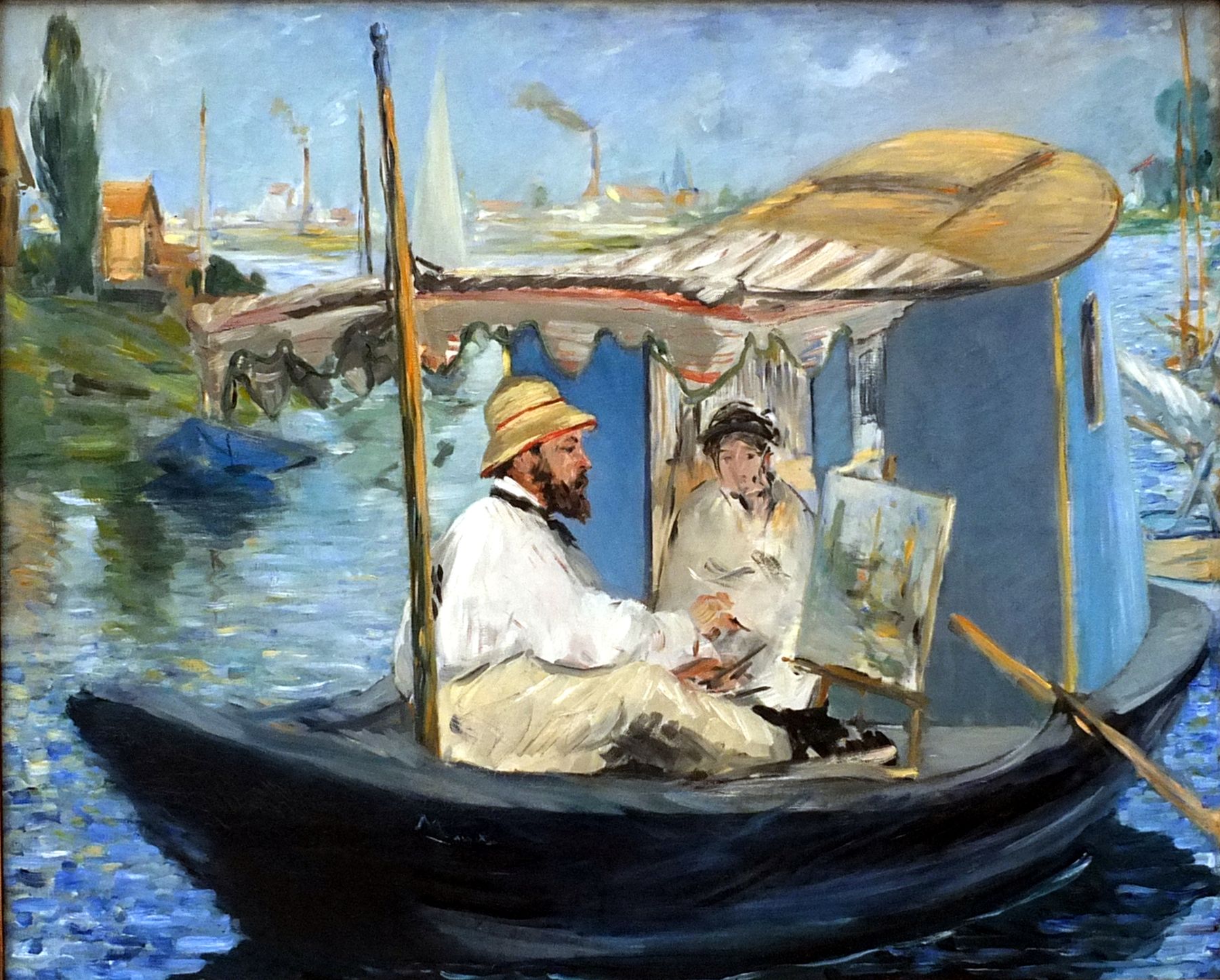
Photograph of Claude Monet's 1874 painting "Die Barke" (The Barge). by Édouard Manet; photograph by Ad Meskens (11 April 2016); Public domain; Wikimedia Commons
Multiple Canvases, One Subject
One of the most practically useful aspects of Monet's method is something that is rarely explained clearly: he did not work on a single canvas at each location. He carried several, often many, canvases to the same spot and rotated between them as the light changed.
The logic is straightforward. If you are trying to capture a specific quality of light — the low angle of early morning sun on a field, or the flat grey diffusion of an overcast afternoon — that condition will only last for a limited time. Monet's solution was not to work faster, but to work systematically across multiple canvases. When the light shifted from the conditions he was trying to capture on one canvas, he set it aside and picked up another that corresponded to the new conditions. He might work on four or five canvases in a single session.
This is not indecision. It is a method for observing with genuine precision. Each canvas became a record of a specific atmospheric state; the series as a whole became a study in how the same subject looks different under different light. Any outdoor painter who has wrestled with shifting conditions can see immediately why this approach makes sense.
The Series Paintings — One Subject, Infinite Light
Monet's series paintings are where this multiple-canvas method scaled up into something remarkable. Over the course of the late 1880s and 1890s, he returned repeatedly to the same subjects across different seasons, different times of day, and different weather conditions, producing groups of work that were not just collections of similar images but sustained meditations on the nature of light itself.
The Haystacks (1888–1891)
The Haystacks series is the clearest example of the series principle emerging from a simple decision. Monet reportedly set out to make a quick study of the haystacks in a field near Giverny, but found himself returning to the same field, in different weather and different seasons, long after any initial sketch would have been finished. He eventually completed around 25 canvases of the same haystacks, working across summer, autumn, and winter, in morning light and afternoon light, in fog and snow and clear sunshine.
The result is one of the most instructive bodies of work in the history of outdoor painting. The haystacks themselves are almost beside the point. The subject has effectively dissolved into an occasion for observing how light behaves at different times and in different atmospheric conditions. What remains is pure sensation: colour, temperature, atmosphere. The form is the constant; the light is everything.
The series painting lesson
Try returning to the same spot at different times of day or in different weather rather than always chasing a new location. Monet's series paintings show that constraint breeds discovery.
Rouen Cathedral (1892–1894)
In 1892, Monet rented a room with a view directly opposite the west facade of Rouen Cathedral and began one of the most obsessive projects of his career. Over two successive winters, he painted the same stone facade repeatedly, producing around 30 versions that each capture a different quality of light falling across the same surface.
There is morning haze dissolving the gothic detail into soft blur; there is the flat, even light of an overcast afternoon; there is the warm gold of late sun striking the carved stone; there is an almost abstract harmony of blue and white. He was not painting architecture. He was painting time, specifically the way time changes light, and the way light changes what we see when we look at something we think we know.
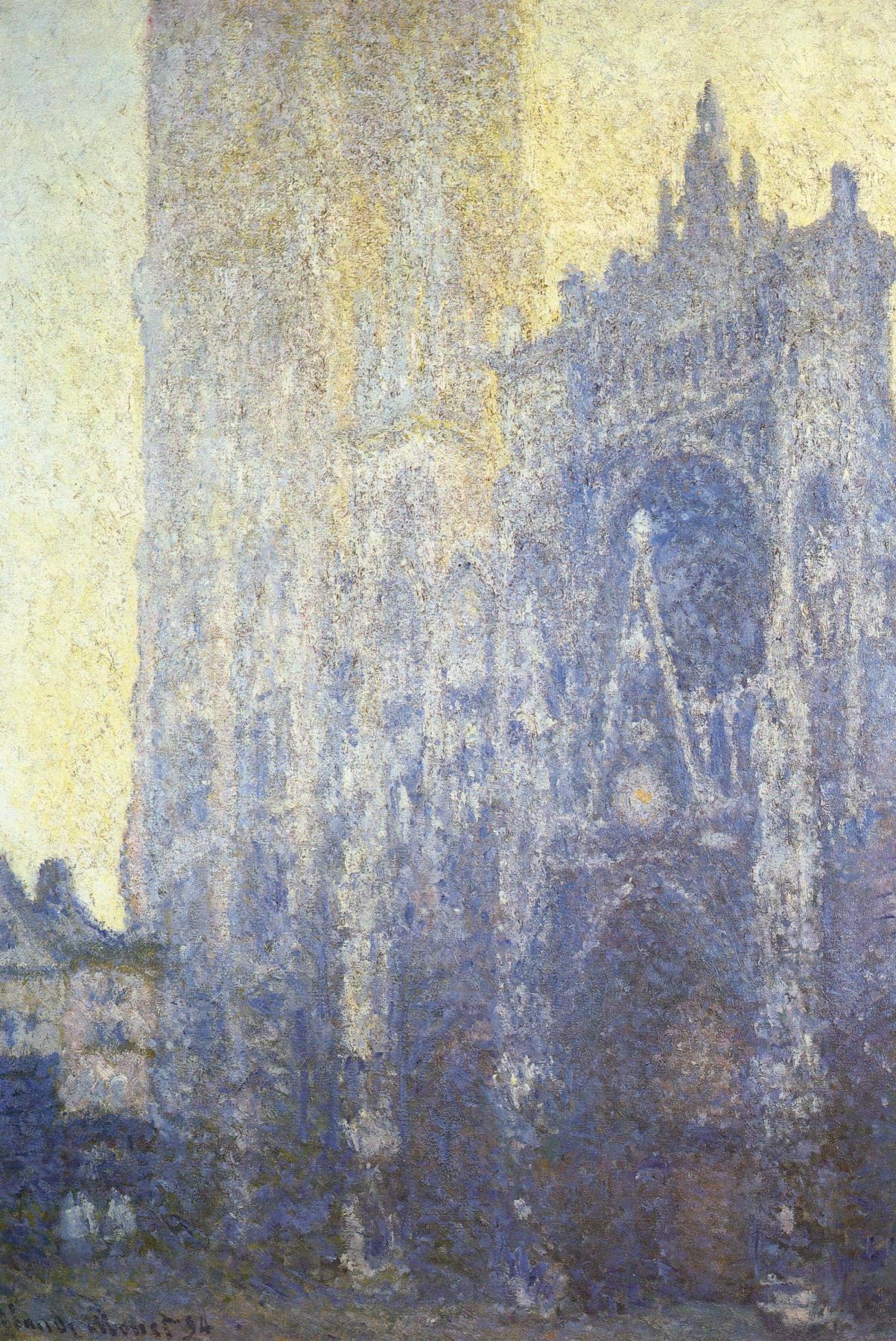
La Cathédrale de Rouen. Le Portail (effet du matin), Claude Monet, 1894. by Claude Monet — Public domain
The Poplars
The Poplars series, painted from the floating barge on the River Epte, produced a group of canvases showing the row of poplar trees that lined the riverbank, their tall forms reflected in the still water below. The paintings are among the most formally elegant of his career: vertical rhythms, curving reflections, a compositional discipline that sits in interesting tension with the fugitive atmospheric effects he was chasing.
What makes the Poplars series particularly worth knowing about is a detail that says a great deal about Monet's seriousness as an outdoor painter. Mid-way through the project, he discovered that the local municipality planned to fell the trees as part of a routine timber sale. Rather than abandon the series, he reportedly negotiated with the buyer to delay the felling until he had finished painting them, covering the cost difference himself. The subject was not going to disappear before he was done with it.
Giverny — When the Painter Made His Own Landscape
By the early 1890s, Monet had achieved a level of financial security that allowed him to buy the property at Giverny outright and begin transforming the garden into something more deliberate. The famous water lily pond was not a natural feature he discovered. It was engineered, designed and redesigned over many years, with the specific intention of creating a subject to paint.
This is a fascinating shift in his practice. Having spent decades travelling to find the landscapes and light conditions he wanted, Monet eventually built his own. The Japanese footbridge, the weeping willows trailing into the water, the lily pads distributed across the surface of the pond: all of it was laid out with an artist's eye for what would happen when the light fell across it.
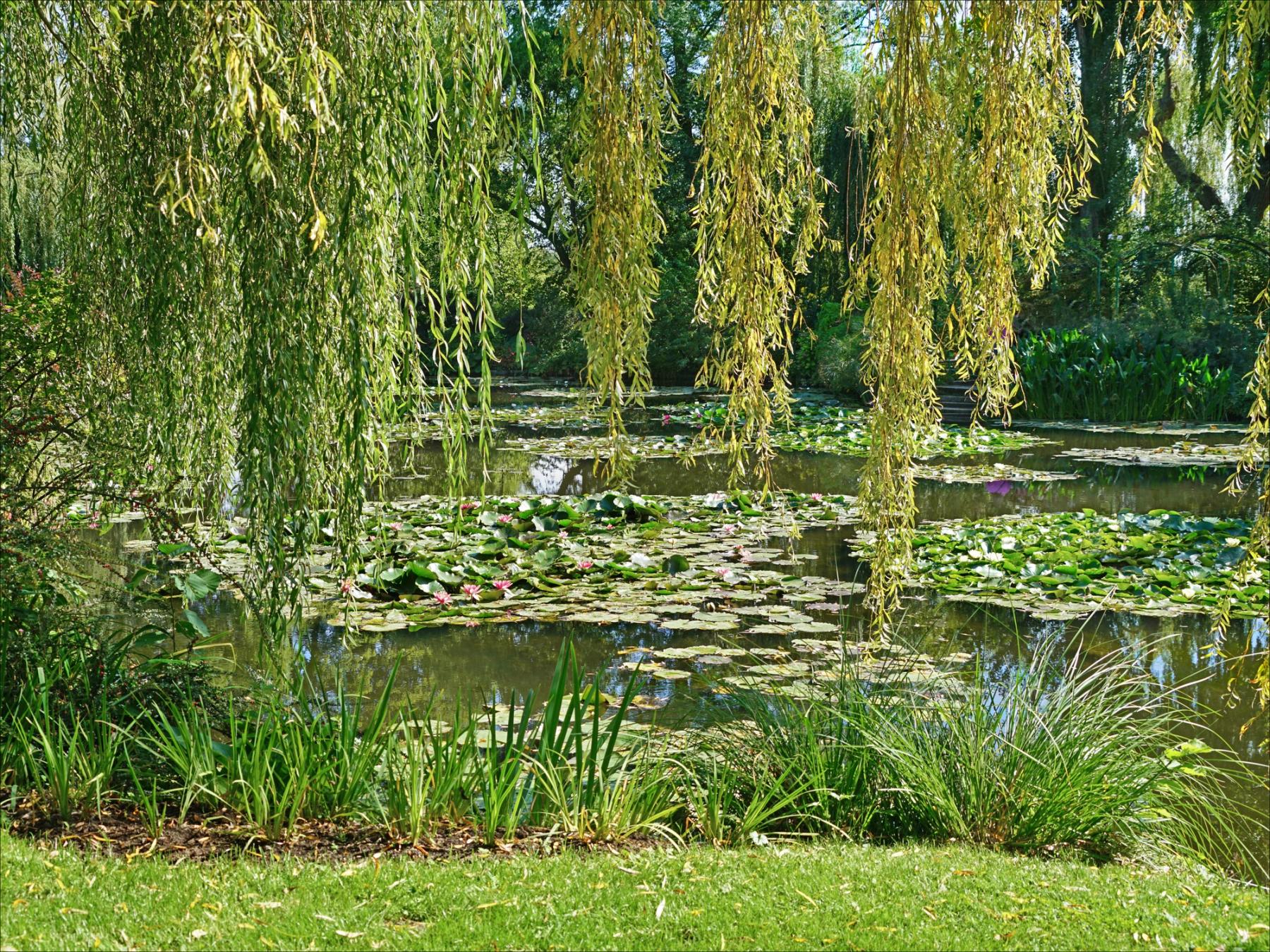
The water garden at Claude Monet's house in Giverny, showing water lilies and a Japanese-style bridge. by Jean-Pierre Dalbéra — Wikimedia Commons, CC BY 2.0
The late water lily paintings, including the enormous Grandes Décorations installed in the Orangerie in Paris, push the plein air philosophy to its furthest point. They were worked on across many years and substantially developed in the studio, especially as Monet's eyesight began to deteriorate in the early twentieth century. But they are rooted, entirely, in the sustained outdoor observation of a single garden over decades. The outdoor practice is still the foundation; the studio work is the transformation of that foundation into something that could not have been achieved on location alone.
Monet by numbers
- Years of serious plein air practice
- ~60 years
- Water lily canvases painted
- 250+
- Haystacks in the series
- ~25
- Rouen Cathedral versions
- ~30
- Size of the Orangerie murals
- 2 metres tall, ~91 metres total
From Boudin's mentorship in the 1850s to failing eyesight in the 1920s
Across the Giverny garden period
Painted 1888–1891
Painted across two winters, 1892–1894
Displayed in Paris; viewable today
What Monet Was Actually After — and What That Means for Us
Monet's stated aim was to capture the impression of a moment: the specific quality of light at a specific time, rather than a literal record of what was in front of him. En plein air painting (French for "in the open air," and the term that gives this approach its name) was, for Monet, not about transcribing a scene faithfully. It was about recording a sensation before it vanished.
He was honest, in his letters, about how difficult this was. He wrote repeatedly about canvases abandoned in frustration, about sessions ruined by rain or wind, about the light changing before he could catch what he was after. He was not immune to any of the challenges every outdoor painter recognises. The difference is that he kept going back.
There is another honesty worth acknowledging here. Many of the series paintings, including the Rouen Cathedral canvases, were finished or substantially reworked in the studio rather than completed entirely on location. This is not a contradiction of his plein air principles. It is a pragmatic response to the reality of outdoor painting: you cannot always finish on site, and the site session is the vital act of looking, not necessarily the final act of painting. The outdoor observation is the irreplaceable foundation. What you do with it afterwards is a separate question.
For UK painters, this is particularly relevant. British weather changes fast. The light on an overcast morning in October has a quality that will be gone within the hour, if not within the minute. Monet, when he came to London between 1899 and 1904 to paint the Thames from his rooms at the Savoy Hotel, was specifically drawn to the fog and atmospheric density of Victorian London, the smog, the diffused winter light, the way the bridges dissolved into the air. He found the British atmospheric conditions actively compelling, not something to work around. The same overcast, changeable light that can feel like an obstacle when you are trying to paint outside in Britain was precisely what he was looking for.
| Common instinct | The Monet shift |
|---|---|
| Painting the scene | Painting the light in the scene |
| Getting the details right | Getting the feeling right |
| Finishing the picture outdoors | Using the session to capture an impression |
| Finding a new location each time | Returning to the same spot as the light changes |
| Waiting for perfect conditions | Working in all weathers — fog, rain, overcast |
Lessons from Monet for Modern Plein Air Painters
The most useful thing Monet's practice offers a painter working outside today is not a specific technique but a shift in how to think about the whole enterprise.
The first and most important is this: find a subject and stay with it. You do not need to drive to a new location every session or chase a different view every time. Monet painted the same hayfield, the same cathedral facade, the same pond for years and found inexhaustible richness there. The subject is not the point. The light is the point, and the light is never the same twice. Any field, any harbour, any park bench you can reach regularly becomes more interesting the more you return to it.
Related to this is the value of working in series rather than in isolated one-offs. Even if you only have an hour or two at a stretch, returning to the same spot at different times of day or in different weather will teach you more than an equivalent number of hours spread across different locations. The discipline of comparison is where the real learning happens.
The specific conditions of British outdoor painting deserve to be embraced rather than apologised for. Overcast skies flatten shadows and create the soft, diffused light that strips away some of the harshness of direct sun. On grey days, the landscape reveals its tonal structure more cleanly than it does in bright sunshine. Monet travelled to London partly because he could not get those conditions in the south of France. If you are painting in the UK, you have them all year round.
On the question of finishing work in the studio: Monet did it, especially as his career matured and his ambitions for individual canvases grew. This is not something to feel conflicted about. The outdoor session is the act of looking, of making contact with the subject, of recording the specific quality of a specific light at a specific time. That is what cannot be faked. What you do with those studies and sketches and incomplete canvases afterwards, whether you call it finished on location or develop it further indoors, is entirely your own business.
And finally: failure is part of it. Monet described, repeatedly, the frustration of sessions that came to nothing, of canvases that would not come together, of conditions that defeated him. He was not a genius floating above the difficulties that ordinary painters face. He was someone who went out anyway, packed up in frustration, and came back the next morning.
Where to Encounter Monet's Plein Air Work in the UK and Beyond
For anyone who wants to see the paintings themselves rather than reproductions, there are options closer to home than you might expect.
The National Gallery in London holds several Monet works, including canvases from the Thames series, the group of paintings he made of Waterloo Bridge and Charing Cross Bridge during his visits between 1899 and 1904. Standing in front of those paintings, in London, near the stretch of river that Monet was looking at from the Savoy, has a particular quality worth seeking out. The National Galleries of Scotland and Tate Modern also hold further works.
For anyone travelling to Paris, the Musée de l'Orangerie is unmissable. The Nymphéas murals fill two oval rooms and create an immersive experience that no reproduction prepares you for. The sheer scale and the quality of attention required to take them in is unlike most things you will encounter in a gallery.
Giverny itself is accessible from London via Eurostar to Paris and a regional train to Vernon. The garden is open to visitors from spring to autumn and is still maintained to Monet's original design.
How to encounter Monet's plein air work
In the UK
The National Gallery (London) holds Thames series works; check the National Galleries of Scotland for further holdings.
In Paris
The Musée de l'Orangerie houses the monumental Nymphéas murals in two oval rooms — among the most immersive experiences in Western art.
In Giverny
Monet's house and garden at Giverny are open to visitors from spring to autumn. The garden is still maintained to his original design.
Online
The Art Institute of Chicago and Musée d'Orsay both have high-quality digital collections that let you study individual works in detail.
A Practice Rooted in Looking
Monet was not insulated from the conditions that make outdoor painting difficult. He was cold. He was rained on. He lost the light before he was ready. He abandoned canvases in frustration and went back the next day, or the next week, or the next season. He made sixty years of work in direct contact with the weather, the landscape, and the specific quality of light that no studio could manufacture.
That commitment, sustained and patient and grounded in direct observation, is what plein air painting is. It does not require genius, or perfect conditions, or a particularly remarkable landscape. It requires showing up in front of something real and looking at it with genuine attention. Monet proved that the same field, the same facade, the same pond, returned to with that quality of attention, can yield a lifetime of discovery.
The subject is outside. It is waiting for exactly the light that is there right now, and in an hour it will be completely different. There is only one thing to do about that.
FAQ
Frequently Asked Questions
What was Monet's approach to plein air painting?
Monet painted directly from nature to record transient light. He worked outdoors in all conditions, often rotating several canvases and returning repeatedly to the same subject to observe changes.
Why did Monet paint series such as the Haystacks and Rouen Cathedral?
He used series to study how light and atmosphere transform the same subject. Each canvas records a specific time and condition, and the group reveals how light alters form and color.
Did Monet finish paintings entirely outdoors?
Not always. Monet used outdoor sessions to capture impressions and may have reworked or completed canvases in the studio. The field study was the essential act of looking.
How can modern outdoor painters use Monet's methods today?
Return to one subject rather than chasing new views, work in short series, rotate multiple canvases as light shifts, embrace local weather, and accept that some studies will be unfinished.
What practical tactics did Monet use when conditions changed?
He carried many canvases and swapped between them as light shifted. He engineered access when needed, for example using a floating barge, and he kept painting in fog, rain, or cold.
Author

PleinAirPainting Editorial Team
PleinAirPainting.co.uk helps artists paint outdoors with confidence through UK-focused guides, equipment advice, resources and plein air inspiration.