PleinAirPainting
The History of Plein Air Painting: From Pig Bladders to Paint Tubes
A concise guide to the history of plein air painting, tracing outdoor practice from early oil sketches and the paint tube through Barbizon, Impressionism, British colonies, and today's revival.

Key takeaways
- • Plein air means painting outdoors and covers tiny sketches to finished oils made on site.
- • The practice predates Impressionism, with 17th and 18th century oil sketches and Valenciennes' teaching shaping outdoor study.
- • Constable and Turner made direct observation central, influencing Barbizon and the Impressionists.
- • The 1841 collapsible paint tube transformed portability and helped make plein air painting widespread.
- • Plein air remains vital today, from British coastal colonies to digital plein air and the modern revival; studio finishing is still common.
Stand outside on a blustery British morning, board propped against your bag, squinting at a sky that has changed three times since you set up, and you are doing something painters have been doing for more than two centuries. The smell of linseed oil on a cold breeze. The particular problem of a shadow that has moved six inches while you were mixing. The quiet satisfaction of getting it down before the light shifts again. The history of plein air painting is longer and more surprising than most people expect, and it starts, in no small part, right here in Britain.
Most people who discover outdoor painting know the rough outline: Constable painted fields, the Impressionists painted in sunshine, and somewhere in between someone presumably invented something useful. The real story is richer than that, and understanding it has a way of changing how you feel about your own practice. This article traces the origins and evolution of outdoor painting from its earliest informal beginnings through to the living tradition it is today.
What Does "En Plein Air" Actually Mean?
You have probably asked yourself this. "En plein air" is French for "in the open air," and in painting it refers to the practice of working directly from nature outdoors, rather than constructing a landscape in the studio from drawings and memory.
In practice, it covers a wide spectrum. A quick watercolour sketch made on a park bench counts. So does a fully resolved oil painting completed in a single session on a clifftop. The line between study and finished work has always been blurry in this tradition, and that ambiguity is not a problem to be resolved; it is one of the things that makes plein air so flexible and so durable. Some of the most celebrated outdoor paintings in history were never intended for exhibition. Some of the roughest, most hurried sketches ended up in major galleries. The point is not the destination but the act of looking directly at the world and responding to it in real time.
Before the Paint Tube: Early Outdoor Painting
To understand how plein air developed, it helps to go back further than most people do. The history of outdoor painting does not begin with the Impressionists, or even with Constable. It begins with artists working centuries earlier, doing what they could with what they had.
Oil Sketches and the Italian Tradition
In 17th-century Rome, artists including Claude Lorrain and Nicolas Poussin would venture into the countryside around the city to make small oil sketches directly from nature. These were not intended for exhibition or sale. They were raw material, reference studies to be taken back to the studio and used as the basis for large, carefully composed landscape paintings.
The habit of sketching outdoors was well established. The limitation was practical: paint was not portable or reliable enough for serious outdoor oil work on any scale. Pigments were stored in small pouches made from animal bladders, or mixed fresh each session. Working outdoors with oil meant managing a fragile, messy, and unpredictable set of materials. The outdoors was a source to draw from, not a place to actually paint.
Britain's Early Landscape Tradition
In 18th-century Britain, a distinct landscape sensibility was beginning to develop. Richard Wilson, sometimes called the father of British landscape painting, made outdoor drawings and studies across Wales and Italy. Thomas Gainsborough worked from small arrangements of moss, stones, and twigs in his studio, reconstructing nature from close observation rather than painting it directly. Both artists were deeply engaged with landscape as a subject, but their major works were finished indoors.
What this period established was a culture of looking: a serious, sustained attention to the British landscape as worthy of artistic attention. That culture would matter enormously when the next generation came along and began to push further.
Pierre-Henri de Valenciennes and the Case for Painting Outside
Before Constable and Turner transformed British painting, a French artist was making the intellectual case for outdoor oil work with unusual clarity and force.
Pierre-Henri de Valenciennes (1750 to 1819) was a painter and teacher who became the first person to advocate outdoor oil painting as a systematic teaching practice. His treatise on landscape painting, published in 1800, made the argument explicitly: students should go outside and paint the sky, the light, and the weather directly from observation. Not to produce finished work, but to train the eye. The outdoors was a classroom, and the changing light was the lesson.
Valenciennes himself made dozens of small oil studies on paper and board, many of which were never shown publicly during his lifetime. They were tools for learning, not objects for exhibition. His approach gained institutional backing at the École des Beaux-Arts in Paris, which began encouraging students to work outdoors as part of their training.
This is a significant moment in the history of outdoor painting. For the first time, painting outside was not just something individual artists did informally; it was a method, endorsed by one of Europe's leading art institutions. The attitude had shifted, even if the technology had not yet caught up.
Constable, Turner, and the British Revolution
If Valenciennes made the case in theory, it was two British painters who transformed outdoor observation into something that would change the course of European art. This is the heart of the British story in plein air painting, and it is a story that deserves to be told at full length.
John Constable and the English Landscape
John Constable did something that sounds simple and was, in practice, revolutionary. He went outside and painted what he actually saw.
Not an idealised version of the Suffolk countryside, not a landscape arranged according to classical rules of composition, but the specific light of a particular morning, the exact colour of a Suffolk sky before rain, the movement of water in the Stour. He returned to the same places repeatedly, Flatford Mill, Dedham Vale, Hampstead Heath, not because he lacked imagination but because he believed that direct, sustained observation was the only way to understand how nature actually worked.
His "skying" studies are among the most remarkable documents in the history of British painting. Made on Hampstead Heath on rapid oil sketches, often no larger than a piece of A4 paper, they record specific weather at specific moments. Constable noted the date, the time, and the direction of the wind on the back of many of these studies. He was not trying to make beautiful paintings. He was training himself to read the sky quickly and accurately.
The larger paintings that resulted from this discipline, including The Hay Wain, completed in 1821, brought this quality of direct observation into fully resolved works. When The Hay Wain was shown at the 1824 Paris Salon, it caused a sensation among French artists. Théodore Géricault had already seen Constable's work and been struck by it. Eugène Delacroix, seeing the painting in Paris, famously repainted sections of his own Massacre at Chios in response. The Barbizon painters who would follow were looking at Constable's work and were changed by what they saw.
Britain's role in the development of plein air painting is not peripheral. It is foundational. The loop from Constable to Barbizon to Impressionism is a real historical chain, and it begins on Hampstead Heath.
What we can learn from Constable's sky studies
Constable made rapid oil sketches of clouds on Hampstead Heath, noting date, time, and wind direction on the back. He wasn't making finished paintings. He was training his eye to read the sky quickly. Next time the light is changing fast, try the same: a small panel, a short time limit, and the goal of capturing one thing accurately.
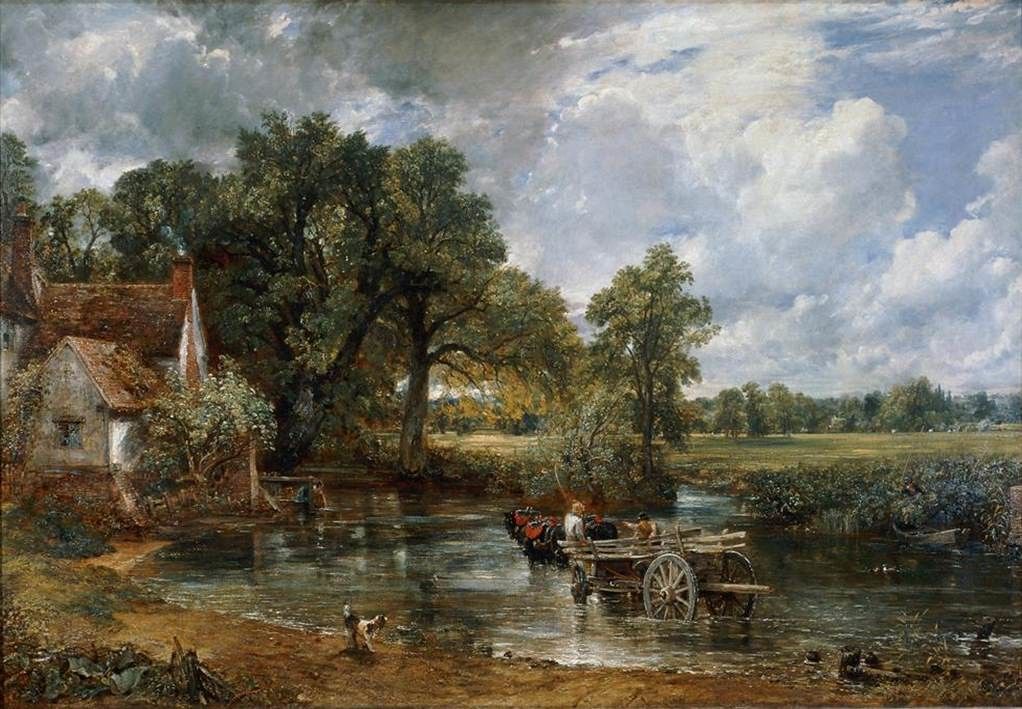
Photograph titled "the hay wain." by KCC246F / Flickr — CC BY-ND 2.0
J.M.W. Turner and the Art of Observation
Turner's relationship with outdoor painting was different from Constable's, but no less important. He was a relentless traveller and an obsessive observer. His notebooks, filled with rapid pencil sketches made on site across Britain and Europe, run to hundreds of volumes. He recorded light, weather, the movement of water, the geometry of harbours, the particular quality of an overcast sky above a Welsh mountain.
These notebooks were not finished works. Turner's major paintings were studio pieces, constructed from accumulated observation and transformed through his extraordinary visual memory. In the strictest definition, he was not a plein air painter in the way Constable sometimes was.
But what Turner did was establish observation as the central discipline of the landscape painter. The idea that you go outside and look, really look, as the foundation of everything you make in the studio: that is a plein air sensibility even when the finished work is made indoors. His treatment of light, weather, and atmosphere as the real subjects of a painting, rather than the objects in the landscape, would shape everything that came after.
The Invention That Changed Everything
In 1841, an American artist working in London changed the practical conditions of outdoor painting so completely that it is difficult to overstate the significance of what he did.
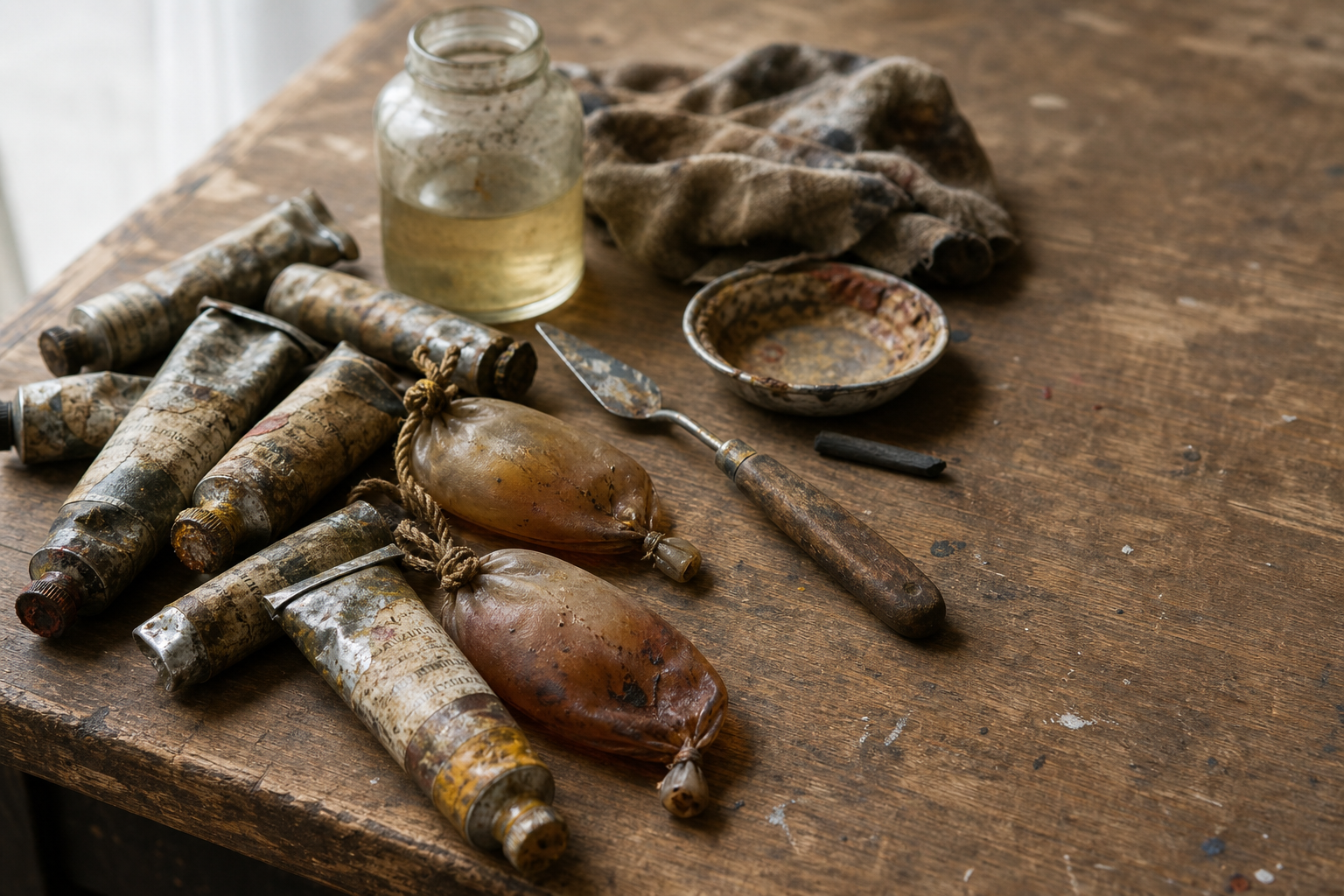
John Goffe Rand was a portrait painter who had spent years struggling with the same problem every oil painter knew: how do you keep paint usable between sessions? The solution available at the time was to store pigment in small pouches made from pig bladders. This worked, after a fashion. The bladder was filled with mixed pigment, tied off, and punctured with a tack when paint was needed. It was messy, unreliable, and prone to drying out. Bladders burst. Paint hardened. Working outdoors with this system meant carrying fragile, improvised containers that had no reliable way of being resealed.
Rand's solution was the collapsible metal tube: a small, sealed container that could be rolled up from the bottom as the paint was used, keeping the remaining paint fresh and the whole thing genuinely portable. He patented it in London in 1841.
The effect on outdoor painting was direct and immediate. Paint was now portable, consistent in quality, and long-lasting. An artist could carry a selection of colours in a small box, work outside for hours, and come back the next day with the same paints still usable. The practical obstacles to serious outdoor oil work did not disappear overnight, but the central one had been removed.
A remark is often attributed to Renoir: that without the paint tube there would have been no Impressionism. The attribution is almost certainly apocryphal, and Renoir may never have said it. But the underlying point stands. The explosion of outdoor oil painting in the second half of the 19th century, the Barbizon School, the Impressionists, the plein air colonies that spread across Europe, all of this happened after 1841, and the paint tube was a significant reason why.
The paint tube in numbers
- Year of invention
- 1841
- Previous method
- Pig bladders
- Impact
- Outdoor oil painting at scale
Patented by John Goffe Rand in London
Dried out quickly and often burst
Enabled Impressionism and plein air as a mass practice
The Barbizon School: Painting in the Forest
In the 1830s and 1840s, a group of French painters began making their way to the village of Barbizon, on the edge of the Forest of Fontainebleau south of Paris. What they were doing there was not casual or occasional. It was systematic.
Théodore Rousseau, Jean-Baptiste-Camille Corot, Charles-François Daubigny, and Jean-François Millet were working outside as a method, not as a novelty. They painted the forest in different seasons and different weathers, the peasants who worked the land, the particular quality of light in a clearing at midday or a field at dusk. They were not painting picturesque landscapes in the classical sense. They were painting what was actually there.
The connection to Constable is direct. Several Barbizon painters had seen The Hay Wain at the 1824 Paris Salon, and the impact of that painting, its quality of observed light, its sense of a specific English morning rather than a general idea of countryside, was part of what drew them toward direct outdoor work. Constable had shown that this was possible. The Barbizon painters made it a practice.
What they developed became the bridge between early British plein air and the Impressionist revolution that followed. They worked in darker tonal ranges than the Impressionists would, and their subjects were rooted in rural labour and seasonal change rather than leisure and light. But the principle, that the landscape should be observed directly and painted honestly, was the same.
The Barbizon approach to simplification
Barbizon painters often worked on dark-toned grounds, which helped them judge values quickly in outdoor light. They blocked in large masses first and left detail for last, or left it out entirely. This is just as useful today when you're working against changing light or a shortening weather window.
The Impressionists and the Open-Air Revolution
By the 1860s and 1870s, a new generation of French painters had taken the principles established by Constable and the Barbizon School and pushed them further than anyone had before.
Claude Monet, Pierre-Auguste Renoir, Camille Pissarro, Alfred Sisley, and Berthe Morisot were not making outdoor studies as preparation for studio paintings. The outdoor painting was the point. Light, colour, and atmosphere were not incidental qualities to be noted and reproduced later; they were the actual subjects of the work. A painting made quickly outdoors, capturing the light of a specific moment on a specific day, was not a sketch or a preliminary; it was the finished thing.
This was genuinely radical. Academic painting valued careful construction, smooth surfaces, and a certain kind of authority that came from the studio. The Impressionists produced canvases that looked, to many critics of the time, unfinished: rough brushwork, unexpected colours, compositions that seemed accidental. The argument they were making, that a painting of this kind was more truthful, more honest, more alive than a carefully constructed studio piece, took decades to win.
Monet's series paintings, the haystacks, the Rouen Cathedral facade, the Thames in London, extended this logic further. Painting the same subject under different conditions was a way of showing that light itself was the real subject, and that a landscape at dawn and the same landscape at noon were, in an important sense, different paintings.
It is worth saying, for UK readers in particular, that the Impressionist chapter is the most famous part of this story but not the whole of it. The French achievement was real and significant, but it grew from roots that run through Britain. Treating Impressionism as the origin of outdoor painting misses the longer and more interesting story.
Women were part of the Impressionist movement in ways that older accounts often underplay. Berthe Morisot was not a peripheral figure; she exhibited in seven of the eight Impressionist exhibitions and was one of the most technically accomplished painters in the group. Mary Cassatt, though American, worked closely within the circle. These women painted outdoors in a period when the social expectations around women's movement and public behaviour made outdoor work genuinely more complicated than it was for their male counterparts. Their names are only now being given the prominence they deserve.
Britain's Own Plein Air Colonies
While the Impressionists were transforming French painting, something parallel and distinctly British was developing closer to home.
The Newlyn School
In the 1880s, a group of artists began arriving in Newlyn, a fishing village on the far western tip of Cornwall. They had come partly for the light, which in the far southwest has a particular quality: clear, northern, consistent, very different from the golden warmth of Mediterranean light that attracted artists to France and Italy. But they had also come for the subject matter.
Stanhope Forbes, Walter Langley, and the painters who gathered around them were not painting picturesque views for parlour walls. They were painting fishing communities: boats being unloaded in early morning light, women mending nets on the quayside, fishermen in bad weather. The subjects were unglamorous, often physically difficult to paint, and rooted in the reality of working life in a specific Cornish place.
This was plein air painting with a social dimension. The Newlyn painters were interested in what was actually in front of them, which included poverty, hard labour, and the particular beauty of ordinary life. Forbes's A Fish Sale on a Cornish Beach, painted in 1885, was made entirely outdoors, in all weather, with the actual fish market in progress. It is one of the most ambitious plein air works ever made in Britain.
The Newlyn approach matters for UK painters today because it established something important: that painting what is actually around you, including the unflattering, the industrial, and the unglamorous, is not a compromise. It is the tradition.
Staithes and Other Coastal Colonies
The pattern at Newlyn repeated itself elsewhere along the British coast. At Staithes in Yorkshire, a group of painters gathered from the 1880s onward, drawn by a fishing community clinging to a steep cleft in the North Sea cliffs. The light there was different from Cornwall: harder, colder, with a particular drama that suited the subject. The artists who worked at Staithes, including Laura Knight in her early career, were developing a British plein air tradition that owed as much to local landscape and working life as to any Continental influence.
Women Painting Outdoors
Laura Knight deserves particular mention. She worked outdoors in Cornwall from around 1907, often on large canvases, and her paintings of beach life and circus performers brought her considerable public recognition. She was made a Dame in 1929 and became the first woman to be elected a full member of the Royal Academy since its founding. She was not exceptional in working outdoors; women were present in the plein air colonies from the beginning, painting alongside their male counterparts. What was exceptional was the degree to which their work was exhibited, collected, and remembered. That imbalance is being corrected, slowly, in galleries and in accounts like this one.
Plein Air in the 20th Century and Beyond
Outdoor painting did not stop when the Impressionist moment passed. In Britain, it continued to evolve through the 20th century in ways that are often overlooked.
The St Ives School, which gathered in Cornwall from the 1940s, drew on the same quality of light that had attracted the Newlyn painters, but in a very different spirit. Artists including Peter Lanyon, Patrick Heron, and Barbara Hepworth were responding to specific Cornish places, the particular blue of the sea on a summer afternoon, the geometry of the Porthmeor headland, but the paintings they made moved toward abstraction rather than representation. Direct observation of place remained central even as the visual language changed. Lanyon, who painted the Cornish landscape from gliders to understand it from the air, is a reminder that "painting from nature" does not have a single form.
The Neo-Romantic painters of the 1940s, John Piper and Graham Sutherland among them, found a different relationship with outdoor painting: deeply personal, often responding to the drama of specific British places under wartime conditions. Piper's bombed churches and dramatic Welsh mountains, Sutherland's Pembrokeshire coastlines, both rooted in a tradition of going to a specific place and responding to what is actually there.
Plein air never disappeared from British painting through the 20th century. It became one strand among many, coexisting with abstraction, figuration, and conceptual work, without ever quite losing its grip on painters who wanted to stay in direct contact with the visible world.
The current revival of interest in outdoor painting is, in some ways, the latest chapter in this continuing story. Affordable portable kit, social media communities where painters share daily outdoor work, plein air events and competitions growing in number across Britain, and a post-pandemic turn toward local landscape and the immediate environment: all of this has brought new painters to outdoor work and reconnected experienced ones with its particular disciplines. Digital plein air is now a genuine category too: artists working with tablets outdoors, applying the same observational principles to a different medium. The tools keep changing. The practice does not.
What This History Means for You
All of this is interesting, but here is the part that matters most.
You do not have to finish the painting outside. Constable, Corot, and the Barbizon painters often did not. Blocking in the key relationships of light, colour, and tone on site and refining or resolving the painting later in the studio is not a compromise. It is one of the oldest and most respected approaches in the tradition.
A quick sketch in the park is genuinely plein air. The tradition began with small studies, not large finished canvases. Valenciennes was advocating twenty-minute oil studies. Constable's sky sketches are tiny. The idea that you need a long session and a resolved painting to be doing "real" plein air work is not supported by the history.
British weather is not an obstacle; it is the subject. Constable made it the centrepiece of his practice. The Newlyn painters built their careers in Cornish squalls. The particular drama of a changing British sky, which can move from flat grey to brilliant light in twenty minutes, is exactly what this tradition was developed to capture. The weather is not in your way. It is the point.
Painting what is actually around you is in the tradition. The Barbizon painters painted peasants and forest clearings. The Newlyn painters painted fish markets and working harbours. If what is in front of you is a canal, a housing estate, or a supermarket car park with an interesting sky, you are not falling short of some romantic ideal. You are in good company.
You are part of a 200-year tradition that began partly in this country. That is not a small thing. Every time you set up outside and try to read the light honestly, you are doing what Constable did on Hampstead Heath, what Forbes did on the Cornish quayside, what Corot did in the Forest of Fontainebleau having been changed by what he saw of Constable's work in Paris.
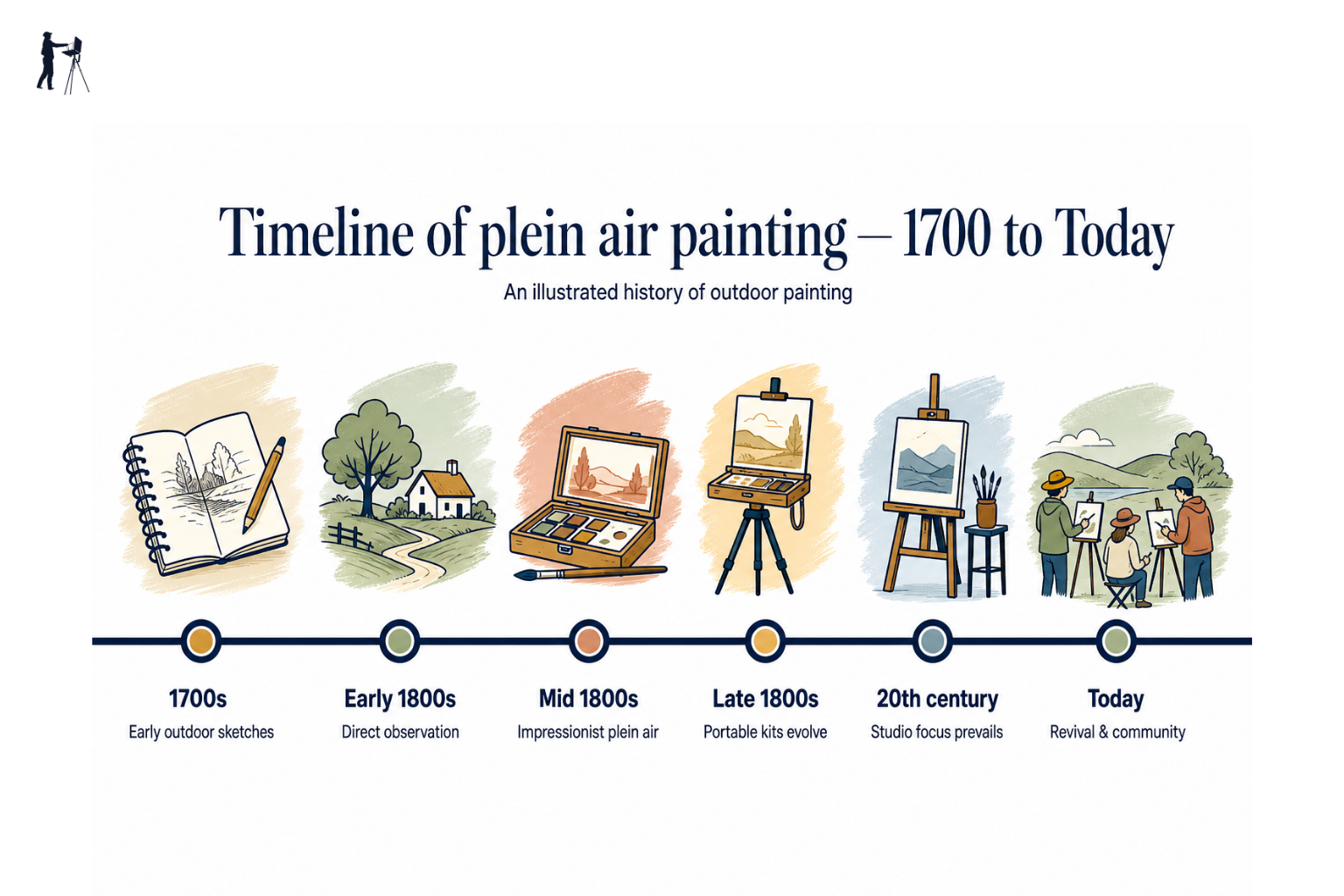
How plein air painting developed
Outdoor sketching as preparation
17th–18th century artists sketched outside to gather material for studio paintings. The outdoors was a source, not the destination.
Painting light directly from nature
Valenciennes and others began advocating outdoor oil studies as a way to train the eye. The goal was learning, not exhibition.
British painters transform the approach
Constable and Turner made direct observation central to finished work, influencing French painters and shifting the course of landscape painting.
Technology makes it practical
The collapsible paint tube (1841) made outdoor oil painting possible at scale. Artists no longer had to wrestle with pig bladders and improvised containers.
Barbizon and Impressionism
French painters built on British influence and the new technology to make plein air the defining method of modern landscape painting.
British colonies and the wider world
Newlyn, Staithes, St Ives, and other British centres developed their own plein air traditions, rooted in place and working life.
The practice today
Plein air is alive, flexible, and growing. Every time you set up outside, you are continuing a tradition that began in this country more than 200 years ago.
The next time you prop a board against your bag and squint at the light, you are doing what Constable did on Hampstead Heath, what the Newlyn painters did on the Cornish quays, and what Monet did in the fields of northern France. The context does not change what you are doing, but it might change how you feel about doing it. That is usually enough to make you want to go outside and try again.
FAQ
Frequently Asked Questions
What does "en plein air" mean?
En plein air is French for "in the open air" and refers to working directly from nature outdoors. It includes quick sketches, studies, and fully resolved paintings made on site.
Did plein air painting begin with the Impressionists?
No. Its roots go back to 17th and 18th century oil sketches and the teaching of Pierre-Henri de Valenciennes. Constable, Turner, and later the Barbizon painters shaped the practice long before Impressionism.
Why is the paint tube so important to this history?
The collapsible metal paint tube, patented in 1841 by John Goffe Rand, made oil paint portable and long lasting. That practical change allowed outdoor oil painting to be done at scale and helped enable the Impressionist surge.
Do I have to finish a painting outdoors to be doing plein air?
No. Many artists historically made small studies on site and completed or refined works in the studio. Blocking in the key relationships outside is a respected and time honored approach.
How should I handle changing British weather when painting outside?
Work small and fast, focus on value and colour relationships, use a dark toned ground or large mass blocking to judge values quickly, and treat shifting light as the subject rather than an obstacle.
Author

PleinAirPainting Editorial Team
PleinAirPainting.co.uk helps artists paint outdoors with confidence through UK-focused guides, equipment advice, resources and plein air inspiration.