PleinAirPainting
The Women Who Shaped Impressionism: Morisot, Cassatt and Bracquemond
Morisot, Cassatt, Bracquemond and Gonzalès moved from margin to centre, showing how domestic and garden subjects, bold cropping and vivid colour reshaped Impressionism.

Key takeaways
- • Women were central to Impressionism not peripheral and new scholarship has restored their status.
- • Social constraints shaped subjects and produced formal innovations in domestic and garden settings.
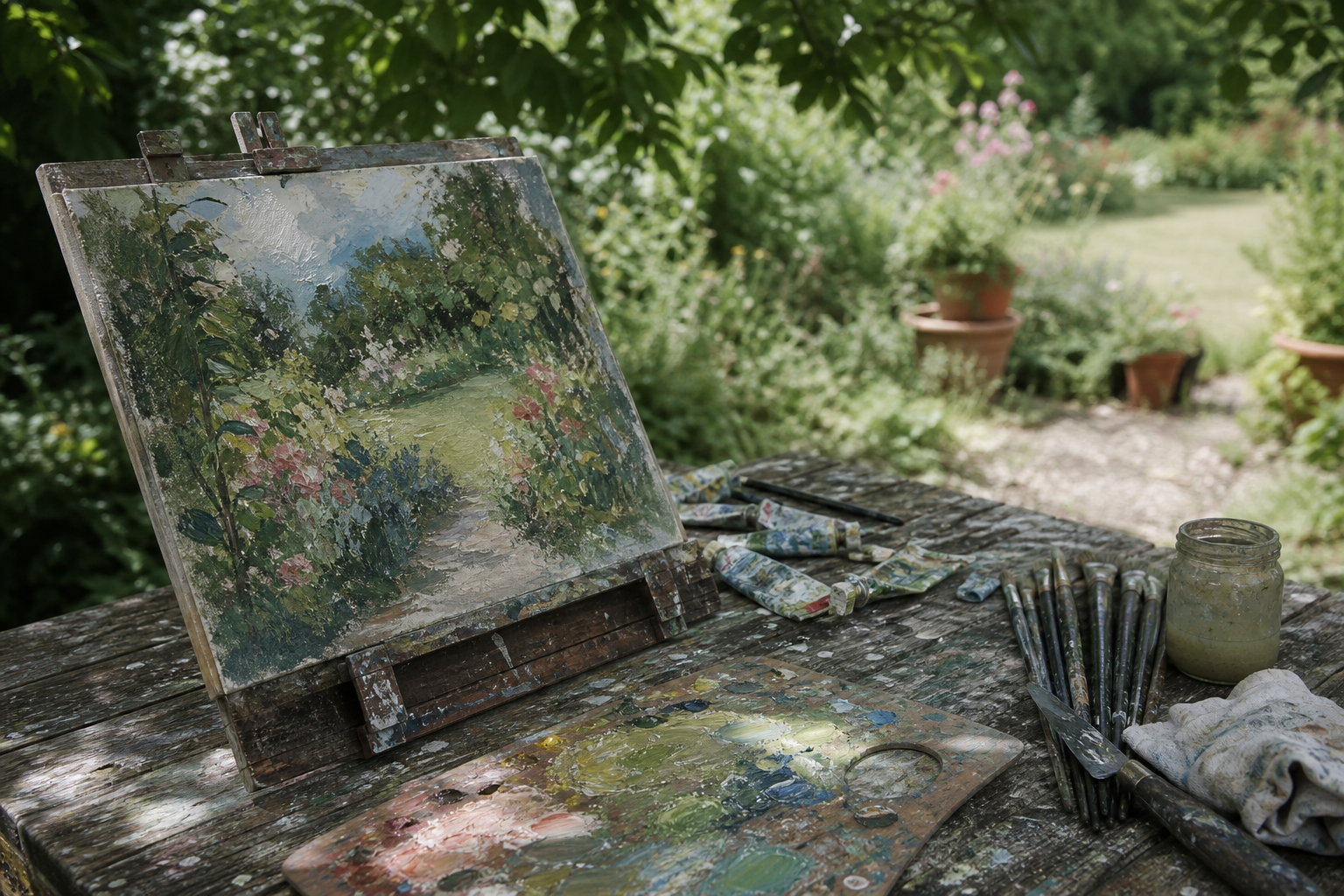
- • Morisot shows how domestic plein air and open passages can be radical and instructive.
- • Cassatt demonstrates bold cropping and printmaking as compositional tools.
- • Bracquemond offers lessons in vivid colour and how constraints can spur originality.
They exhibited alongside Monet and Degas. They painted with the same radical freedom, the same broken light, the same rejection of academic convention. And yet, for much of the twentieth century, women Impressionist painters were treated as footnotes in a story that was largely written around men. That is now changing, and changing quickly. Major institutions on both sides of the Channel are reframing how Impressionism is told, and the names Berthe Morisot, Mary Cassatt, Marie Bracquemond, and Eva Gonzalès are moving from the margins to where they always belonged: at the centre of the movement. This article is an attempt to introduce these artists properly, to look at their work seriously, and to draw out what practising painters today can genuinely take from their example.
Not on the Margins: Women at the Heart of Impressionism
Impressionism emerged in Paris in the 1860s and 1870s as a conscious break from the French academic tradition. Where the Salon demanded polish, finish, and historical or mythological subject matter, the Impressionists painted the present: parks, rivers, café terraces, suburban gardens, and the play of natural light on all of it. The first Impressionist exhibition, held in 1874, was deliberately independent of the Salon, and it attracted derision from critics before eventually becoming one of the defining moments in Western art history.
Four female Impressionist artists were part of this story from the beginning, or close to it. Berthe Morisot showed in the first exhibition and in six of the seven that followed. Mary Cassatt joined the circle by 1877 at the invitation of Degas and exhibited with the group across four shows. Marie Bracquemond showed in three of the eight exhibitions. Eva Gonzalès, though she never exhibited with the Impressionists directly, worked in the same spirit and was the only formal pupil Édouard Manet ever took on.
Critics at the time grouped Morisot, Cassatt, and Bracquemond together under the phrase "Les Trois Grandes Dames", the three great ladies of Impressionism. The label acknowledged their standing while simultaneously separating them from the men, which tells you something about how the art world handled talent it couldn't quite ignore. A century later, the label has been reclaimed: it reflects genuine status, not polite condescension.
This is not a matter of feminist revisionism retroactively promoting minor figures. The scholarly and curatorial consensus, as reflected in the Dulwich Picture Gallery's landmark 2023 exhibition "Berthe Morisot: Shaping Impressionism" and the National Gallery of Ireland's 2024 "Women Impressionists" show, is that these artists were central to the movement. Understanding their work deepens our understanding of Impressionism as a whole.
Berthe Morisot and the Art of Painting Outdoors
A pioneer in plain sight
Berthe Morisot was born in 1841 and died in 1895. She showed work in seven of the eight Impressionist exhibitions, a record that most of the men in the group did not match. Monet showed in five; Renoir in four. Morisot was there for nearly all of it.
Her relationship with Édouard Manet has sometimes been reduced to biographical gossip, but its professional dimension is more interesting. She modelled for several of his paintings and, in 1874, married his brother Eugène. More importantly, the two artists influenced each other's work in ways that scholars are still tracing. Manet loosened his brushwork during the years of their friendship. Morisot was already thinking about light and surface in ways that were genuinely ahead of the curve.
Art historians now describe her as one of the most innovative painters in the Impressionist group, not "the female one", not "Manet's sister-in-law", but a painter whose handling of colour, atmosphere, and figure was distinctive and influential in its own right.
An impressionist pastel landscape titled "Lake Bois de Boulogne (1879)." by rawpixel (via Openverse) — CC0 1.0
Painting where a woman could paint
Here is where Morisot's story becomes particularly important for anyone interested in plein air painting. The Impressionist men could walk freely through Paris: into the cafés along the boulevards, through the working-class districts, along the riverbanks and into the unaccompanied spaces of city life. Morisot could not. Bourgeois women in 1870s Paris did not walk alone in public. To do so was to invite assumptions about class and respectability that a woman of her background could not afford.
So Morisot painted where she could go: gardens, balconies, verandas, the seaside, and the domestic spaces of women's social lives. Scholars now describe these as "threshold" spaces, places positioned between interior and exterior, between private and public. Far from being a limitation that confined Morisot to lesser subjects, these spaces became a laboratory for some of the most formally interesting work in the entire movement.
Her Berthe Morisot plein air practice in these semi-private settings produced a handling of light that is immediately recognisable: figures that seem to dissolve into their surroundings, brushwork that is rapid and broken, passages that read as genuinely unfinished by academic standards but are, on closer inspection, precisely judged. The figure and the garden are treated as the same problem. Light falls across both with the same flickering touch.
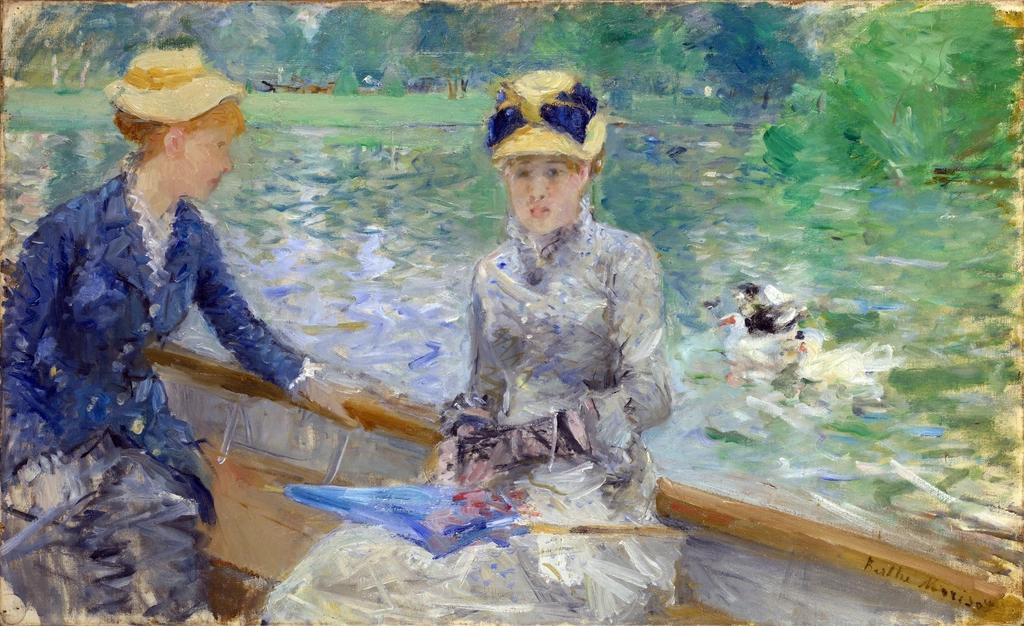
Summer's Day (held at the National Gallery in London) shows two women in a rowing boat, the water and the figures rendered with the same loose, confident marks. The Cradle (Le Berceau, Musée d'Orsay) turns a domestic interior into a meditation on weight, transparency, and the fall of light on fabric. Neither painting is modest in its ambitions.
What UK painters can learn from Morisot
The practical lesson from Morisot is one that many painters find liberating: you do not need a dramatic landscape or a public setting to paint outdoors. Your garden, your balcony, the view through an open window or across a courtyard, these are legitimate plein air subjects with a genuine artistic lineage behind them.
Morisot also worked small and fast. She accepted unfinished passages as a formal quality rather than a defect, which is far harder to do deliberately than it sounds. If you tend to overwork a painting, studying how she left open passages in her work is genuinely instructive.
The Dulwich Picture Gallery's 2023 exhibition set a new standard for how Morisot is presented and interpreted. The accompanying catalogue remains in print and is worth buying even now, offering the kind of close reading of individual works that a wall visit alone can't quite replicate.
Painting like Morisot
You don't need a dramatic landscape to paint outdoors. Morisot found radical possibilities in gardens, balconies, and the view through an open window. Try working on a small panel in a familiar outdoor space and let some passages remain loose and open. The "unfinished" quality she used so deliberately is harder to achieve than it looks.
Mary Cassatt and the Radical Domestic Interior
An American in Paris
Mary Cassatt was born in Pennsylvania in 1844 and died in France in 1926. She had studied in Philadelphia before moving to Europe to pursue a more serious artistic education, eventually settling in Paris. In 1877, Edgar Degas saw her work in the Salon and invited her to join the Impressionist circle. She was the only American in the core group, and she remained a central figure in it for the rest of the movement's active life.
What made her unusual, even within that unusual company, was the clarity and ambition of her formal thinking. She was not simply absorbing the style of those around her. She was developing her own visual language, shaped in part by a close study of Japanese woodblock prints that was as serious as anything Monet or Degas brought to the same source material.
What her paintings are actually about
There is a persistent tendency to describe Mary Cassatt's paintings as warm domestic scenes, as though warmth were a limitation rather than a quality. The mothers and children she returned to throughout her career have sometimes been read as sentimental, even conventional. This is a significant misreading.
Looking at Mary Cassatt's paintings carefully, what you find are highly structured, formally ambitious works. The Child's Bath (Art Institute of Chicago) crops the figures from above at an unusual angle, creating bold diagonals and flattened areas of colour that owe an explicit debt to ukiyo-e printmaking. The composition is not comfortable or casual; it is designed. In the Loge shows a woman at the theatre, opera glasses in hand, observed while she herself observes, which is a more pointed subject than it might first appear.
Her printmaking practice is sometimes overlooked in favour of the paintings, but it deserves attention. The colour aquatints she produced in the early 1890s, following a major exhibition of Japanese prints in Paris, pushed her formal ideas as far as anything she painted. The combination of bold outlines, flat colour areas, and unusual spatial cropping made them technically innovative by any standard.
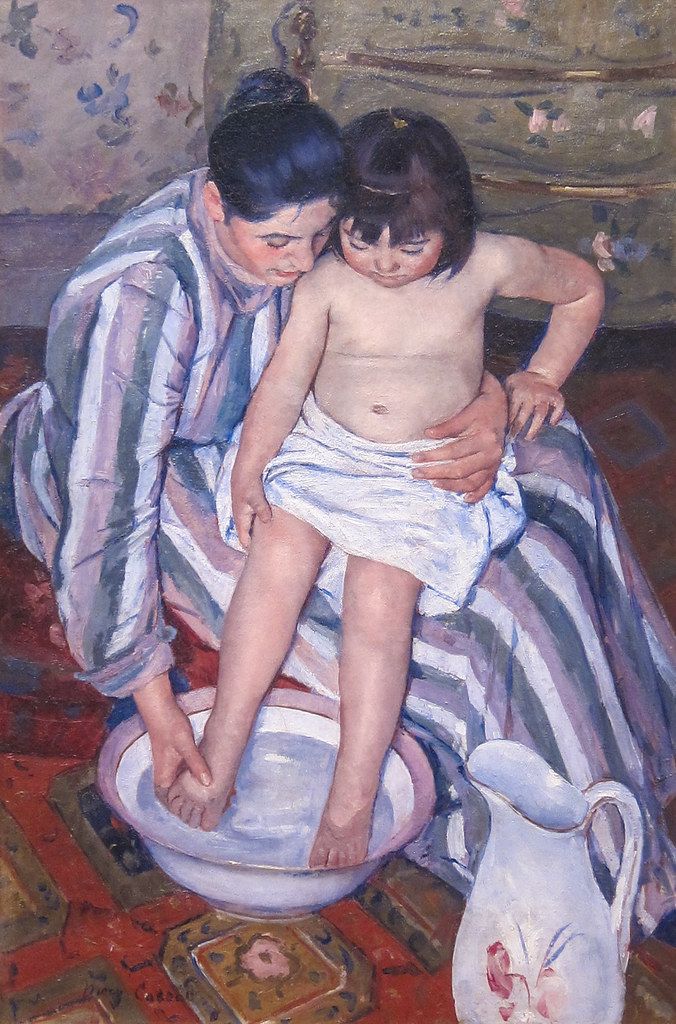
Mary Cassatt's 1893 painting The Child's Bath. by Sharon Mollerus / Flickr — CC BY 2.0
Her influence beyond France
Cassatt's influence extended well beyond her own paintings. She was a trusted adviser to Louisine and H. O. Havemeyer, two of the great American collectors of the late nineteenth and early twentieth centuries, and she directed a significant proportion of their acquisitions toward Impressionist work. Much of what they bought eventually passed to the Metropolitan Museum of Art in New York, which means Cassatt's curatorial instincts now shape one of the most important Impressionist holdings in the world.
For UK visitors wanting to study Cassatt's painting at close quarters, the honest answer is that a trip to the United States is the most rewarding option: the Art Institute of Chicago and the Met hold the strongest concentrations. Paris's Musée d'Orsay also has important works. The National Museum of Women in the Arts in Washington maintains an excellent digital collection for remote study.
Marie Bracquemond: The Impressionist the World Forgot
Brilliance and obstruction
Marie Bracquemond was born in 1840 and died in 1916. She showed in three of the Impressionist exhibitions and produced work of striking originality: saturated, almost vibrating colour, architectural compositions, and figures caught in the particular quality of light that falls through foliage onto a garden table or veranda in full summer.
Le Goûter (Afternoon Tea), now held at the Petit Palais in Paris, is the painting most often used to represent her. It shows figures in a sunlit garden, the light on clothing and on the white table surface handled with a confidence and intensity that places it comfortably alongside the best work in the movement.
And then, around 1890, she largely stopped exhibiting. The reason that scholars now point to is her husband, Félix Bracquemond, a respected etcher in his own right. He reportedly criticised her work consistently, discouraged her from showing publicly, and is believed to have destroyed some of her paintings. She painted quietly at home for the remaining decades of her life. Her public career was, for practical purposes, over.
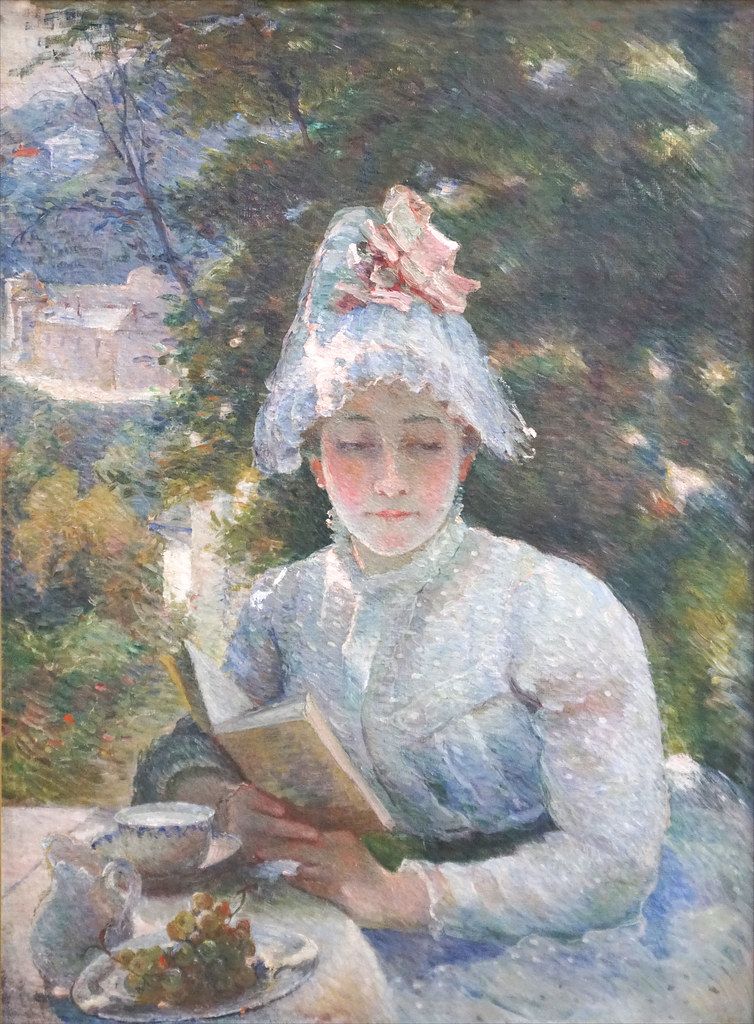
'Le goûter' de Marie Bracquemond on display at the Petit Palais in Paris. by dalbera / Flickr, CC BY 2.0
Why she matters now
Bracquemond's story is now treated by scholars as a clear case of domestic pressure ending an innovative career. Her relative obscurity is not evidence of lesser talent; it is evidence of how effective sustained discouragement can be. The paintings that survive are consistently impressive, and the fact that there are fewer of them than there should be is itself an argument.
Interest in her work has grown steadily over the past decade, with institutions beginning to programme and catalogue her alongside Morisot and Cassatt. The National Gallery of Ireland's 2024 "Women Impressionists" exhibition gave her substantial attention, and the catalogue is a useful current resource for anyone wanting to go deeper.
Seeking out Bracquemond
Bracquemond's work is harder to track down in UK collections than Morisot or Cassatt. If you're planning a trip, the Musée d'Orsay in Paris holds several key pieces. Her story is well told in the National Gallery of Ireland's 2024 "Women Impressionists" catalogue, which is worth tracking down even if the exhibition has closed.
A Note on Eva Gonzalès
Eva Gonzalès was born in Paris in 1849 and died in 1883, aged just 34, shortly after giving birth to her first child. She was Édouard Manet's only formal pupil, and while she never exhibited with the Impressionist group itself (she remained committed to the official Salon), her work belongs to the same current of ideas.
Her paintings have a theatricality that sets them slightly apart: carefully staged poses, controlled but fresh brushwork, a feeling of figures caught in a specific quality of indoor light. They are not quite Impressionist in the strict exhibition sense, but they are clearly the work of someone thinking through the same problems.
Gonzalès complicates any neat account of the movement's boundaries. Impressionism was never a closed club with fixed membership. Its ideas circulated widely, influencing artists who engaged with official structures as well as those who rejected them. Her early death cut short a career that was still developing, and it's genuinely difficult to know what she might have produced over the following decades. What remains is enough to secure her place in this story.
The Constraints That Shaped the Work
Taken together, these four artists worked within a set of structural conditions that shaped what they painted and how. Access to formal art education was restricted: the prestigious École des Beaux-Arts in Paris did not admit women until 1897. Life drawing from the nude, considered essential training, was largely unavailable to women through official channels. And the social conventions governing where bourgeois women could go unaccompanied ruled out most of the public spaces that the Impressionist men painted freely.
The result was a particular set of subjects: domestic interiors, gardens, children, women's social rituals, and the threshold spaces between inside and outside. Scholars studying women artists and Impressionism no longer read these as lesser themes producing lesser work. They read them as conditions that produced a specific kind of innovation: close observation of light on skin and fabric, psychological depth in intimate compositions, formal interest in enclosed and semi-enclosed spaces, and a quality of attention that the cafés and riverbanks simply didn't demand in the same way.
The domestic plein air distinction is worth sitting with: there is public plein air, where you move through the world painting what you encounter, and there is semi-private plein air, where you work within a bounded space, often a garden or a courtyard, with the same commitment to observed light and atmosphere. The second category produced some of Impressionism's most formally interesting work. It also maps neatly onto spaces that most UK painters have access to right now.
Four women, one movement
- Berthe Morisot
- Exhibited in 7 of 8 Impressionist exhibitions
- Mary Cassatt
- Invited by Degas, 1877
- Marie Bracquemond
- Withdrew c.1890
- Eva Gonzalès
- Died aged 34, 1883
The most exhibited woman in the group
Only American in the core circle
Domestic pressure ended her public career
Never exhibited with the Impressionists; Salon artist
Seeing the Work in the UK and Ireland
For UK readers wanting to encounter these paintings in person, options are more limited than they should be, but they exist.
The National Gallery, London holds Summer's Day by Morisot, and it is one of the best places in the country to see her work in a permanent collection. The Impressionist galleries are worth spending time in, and the wall texts and audio guides increasingly address questions of who is present and who is absent from the canon.
The Courtauld Gallery, London has strong Impressionist holdings and has been thoughtful in recent years about how it frames questions of gender and access within its interpretation. Even if Morisot and Cassatt are not always prominently represented, the context the Courtauld provides for the movement is valuable.
The Dulwich Picture Gallery mounted the landmark 2023 Morisot exhibition "Berthe Morisot: Shaping Impressionism", which attracted considerable attention and critical respect. The exhibition has closed, but the scholarly catalogue remains available and is among the best English-language resources on her work currently in print.
The National Gallery of Ireland, Dublin hosted "Women Impressionists" in 2024, covering Morisot, Cassatt, Bracquemond, and Gonzalès in depth. The show has closed, but Dublin is reachable from most UK cities and the NGI's permanent collection is worth the trip independently. The exhibition catalogue is a current, authoritative resource and well worth tracking down.
For those who can't travel, the Musée d'Orsay maintains a high-quality digital collection online, with good resolution images of key works by all four artists. The Art Institute of Chicago and the National Museum of Women in the Arts in Washington also maintain strong online resources. Studying brushwork and surface from these images before or instead of travel is genuinely useful, especially for Cassatt and Bracquemond, whose major works are predominantly outside the UK.
What These Painters Offer the Practising Artist Today
The most useful thing about this history, for a practising painter, is that it refuses the idea that constraints produce only limitation. Morisot, Cassatt, Bracquemond, and Gonzalès worked within real restrictions, and what they produced in response was formally inventive, psychologically rich, and in several cases technically ahead of their time.
From Morisot, the practical takeaway is permission: permission to paint close to home, in small formats, with rapid marks and open passages in places you can actually get to. The garden, the balcony, the view across a courtyard, these are not compromises. They are a legitimate tradition with a serious artist at its root.
From Cassatt, there are at least two things worth taking directly into your own work. The first is boldness with cropping: she thought about the edge of the canvas as an active compositional tool, cutting figures and objects in ways that create tension and depth. The second is the willingness to treat domestic life and caregiving as compositionally serious subjects, not merely sentimental ones.
From Bracquemond, the lesson is about colour intensity. Her handling of sunlight on clothing and foliage in Le Goûter and her garden scenes pushes saturation in ways that feel modern even now. If your outdoor work tends toward safe, muted colour, her paintings are a useful corrective.
From the group as a whole, there is something broader: the reminder that working within constraints can produce innovation rather than limitation, and that the subjects closest to hand are often the ones that reward the deepest looking. These were not tragic figures waiting to be rescued by history. They were working painters who understood their conditions clearly and made exceptional art within them. That, as it happens, is something any plein air painter will recognise.
FAQ
Frequently Asked Questions
Who were the main women Impressionist painters discussed?
Berthe Morisot, Mary Cassatt, Marie Bracquemond and Eva Gonzalès. Each played a central role in the movement and developed distinctive approaches to light, composition and subject.
Why were these women often treated as margins of the movement?
Social and institutional barriers limited where and how women could work. Restricted access to formal training, the Salon system, and expectations about respectable behavior shaped subject choices and public visibility.
Where can I see their work in the UK, Ireland and online?
In the UK see Morisot at the National Gallery and collections at the Courtauld and Dulwich. The National Gallery of Ireland held a recent group show. For remote study use the Musée d'Orsay, Art Institute of Chicago and the National Museum of Women in the Arts online collections.
What practical lessons do these painters offer practising artists?
Paint close to home with seriousness, accept rapid, open passages, use bold cropping and composition, and push colour saturation where light demands it. Constraints can be a source of invention.
How did each artist differ in approach?
Morisot focused on domestic plein air and loose passages. Cassatt used bold cropping and print techniques to structure composition. Bracquemond worked with saturated colour and garden architecture. Gonzalès combined theatrical staging with Manet's influence.
Author

PleinAirPainting Editorial Team
PleinAirPainting.co.uk helps artists paint outdoors with confidence through UK-focused guides, equipment advice, resources and plein air inspiration.